
Suffolk County Bench Warrants Explained
The label is looser than people assume. Bench warrant describes paper the court itself puts out, nearly always because someone skipped something a judge required of them. Massachusetts guidance leans on the phrase default warrant instead, and what the docket actually says is the entry that governs. In Suffolk County, the triggers are everyday events rather than exotic ones. A missed hearing, criminal or civil. A skipped jury-duty date. Unpaid fines, assessments, costs, restitution, or support; an alleged probation violation; or a complaint that moves the court to authorize an arrest. Not every missed date ends the same way. The judge weighing the failure to appear decides what the Suffolk County court does next, and no two dockets move alike.
Suffolk County Bench and Default Warrants
Two words circulate in Massachusetts, and they overlap without being identical.
- Default warrant
- The term used in state guidance and in chapter 276 for process that follows a failure to appear or another default.
- Bench warrant
- A descriptive phrase for a warrant issued from the bench. A public portal may not display it as its own field.
- Probation warrant
- Process tied to an alleged probation violation or surrender, which may require a judge rather than a bail commissioner.
- Payment-only default
- A warrant based solely on an unpaid court obligation, handled under the payment provisions of chapter 276.
How Suffolk County Bench Warrants Are Issued
The paper comes from the court, never a police desk. Skip a required appearance without reasonable cause and chapter 276, section 26 calls it contempt, letting the court issue a warrant on its own process. Rule 6 spells out what the warrant must contain and how officers serve and return it. A judge signs it. It then enters the warrant management system with a serving agency attached, and the case stays open behind it. Recall changes none of that. The charge, fine, or probation obligation in the Suffolk County case stands on its own until the court deals with it separately.
After a Missed Suffolk County Court Date
Boston's first hurdle is picking the right division, since the city holds eight of them. Central sits at 24 New Chardon Street. The rest cover Brighton, Charlestown, Dorchester, East Boston, Roxbury, South Boston, and West Roxbury. Match the address, neighborhood, or police division on your notice to one of them. Then call that division's clerk during business hours and say plainly that you are checking on a default or warrant. Ask if a motion can handle it. Ask if you must appear, and what documentation would help. Dorchester and Roxbury account for the largest share of Boston's warrant volume in the FY2025 report, so their counters field these Suffolk County questions daily and know the local process cold.
Bench Warrants and Arrest Warrants Compared
Either paper lets an officer take a Suffolk County person into custody. They arise differently, though, and each carries its own paperwork trail.
| Point | Bench or default warrant | Arrest warrant |
|---|---|---|
| Origin | A default in an existing case | A complaint or indictment |
| Common trigger | Missed date, unpaid obligation | A new charge or a failure to appear |
| Issuing court | The court that had the case | The court that will hear the charge |
| Resolution | Recall after an appearance, payment, or motion | Recall or bail after an appearance |
Suffolk County Bench Warrants Versus Civil Capias
Paper marked capias is civil, and the criminal warrant counters in Suffolk County cannot touch it. The Sheriff's Civil Process Division at 132 Portland Street serves civil papers, including court-issued civil capias process tied to support and contempt matters. Its phone line is (617) 704-6999. Its email is civilprocess@scsdma.org. By the division's own description, a civil capias needs a court-issued warrant, payment up front, and no fee waiver. Standard civil service runs 5 to 10 business days, while time-sensitive service takes 2 to 5 days. Start with the court that issued the civil process. Then contact Civil Process to get it served in Suffolk County.
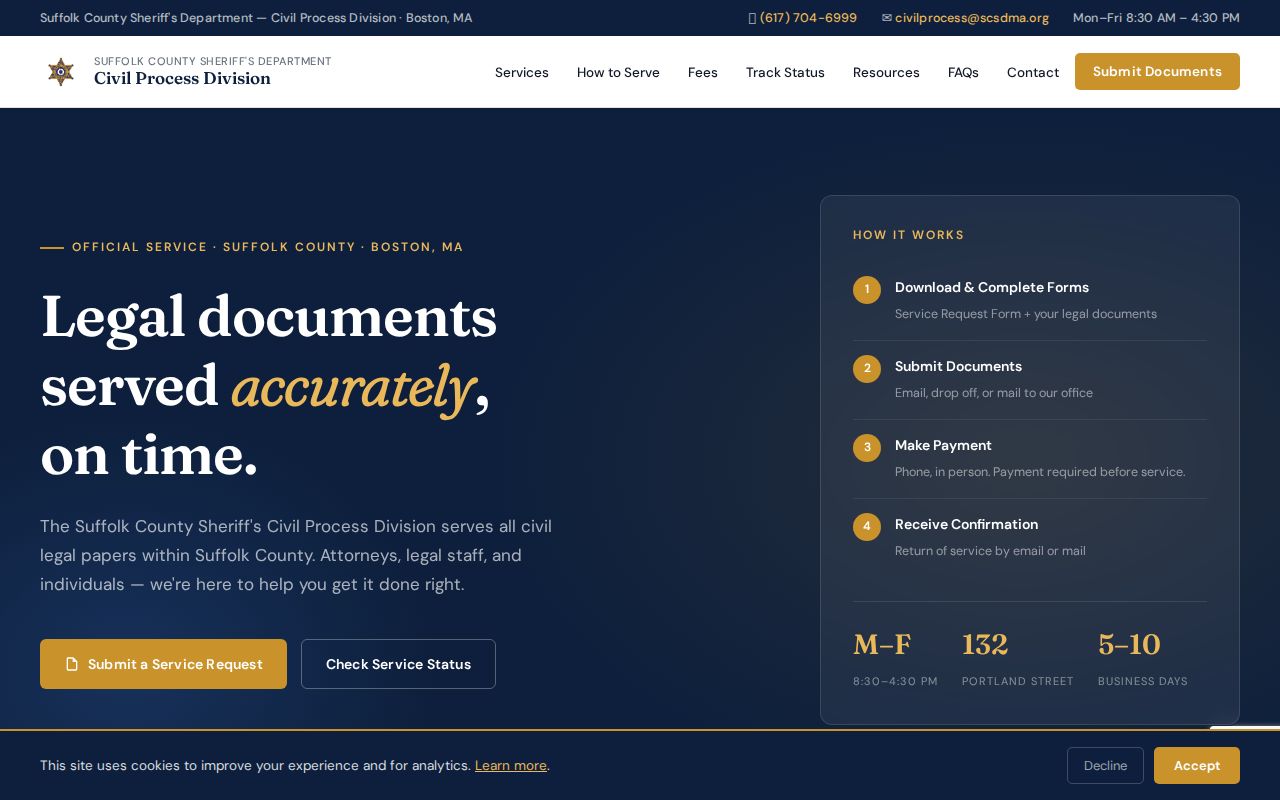
Suffolk County's civil process page lays out service requests and fees, all separate from anything a criminal clerk handles.
Resolving a Suffolk County Bench Warrant
Fixing a Suffolk County bench warrant starts with a phone call and ends with paper. Call the issuing court first. Confirm the location and hours. Then go to the clerk's office and say you are there to clear a default or warrant. The clerk may hand you a form, route the matter to a judge, set a hearing, or tell you counsel is required. Official state material lists two fees. A $50 default-warrant fee applies when a default warrant is recalled or issued solely for failure to pay. A $75 arrest fee follows an arrest on a bail or probation default, under chapter 276, section 30. Either can be waived for good cause or hardship, and the clerk explains how to ask.
Caution: A recall order may take another day or more to appear in public systems, so ask for written proof of the court's action and keep it.
Suffolk County Warrants in Chelsea and Revere
Chelsea and Revere adult lower-court matters land at Chelsea District Court, 120 Broadway. Reach the clerk at (617) 660-9200 or by email at cmchelseadc@jud.state.ma.us. Probation sits at (617) 660-9300. Doors are open Monday through Friday, 8:30 a.m. to 4:30 p.m. Bring the notice, the case number, and anything explaining the missed date, such as a medical record or a work conflict. Ask which form this Suffolk County court wants for a removal request. Ask whether the matter can be heard remotely. The courthouse lists public Wi-Fi and wheelchair access, and bus routes 111, 112, 114, 116, and 117 stop nearby, so the trip is manageable.
Finding the Court That Issued the Warrant
Which court issued your warrant depends on the case itself, not on your address. A case filed in Boston Municipal Court stays with that division. A Chelsea or Revere lower-court case belongs to Chelsea District Court instead. Felony indictments land in Suffolk Superior. There, the criminal clerk works from the 14th floor at 3 Pemberton Square, and the office answers at (617) 788-8160. Juvenile matters go to whatever Juvenile Court session the case was assigned to. One practical tip helps: the criminal clerk sits one floor above the civil clerk and several floors above probation, so ask for the criminal counter at Pemberton Square.
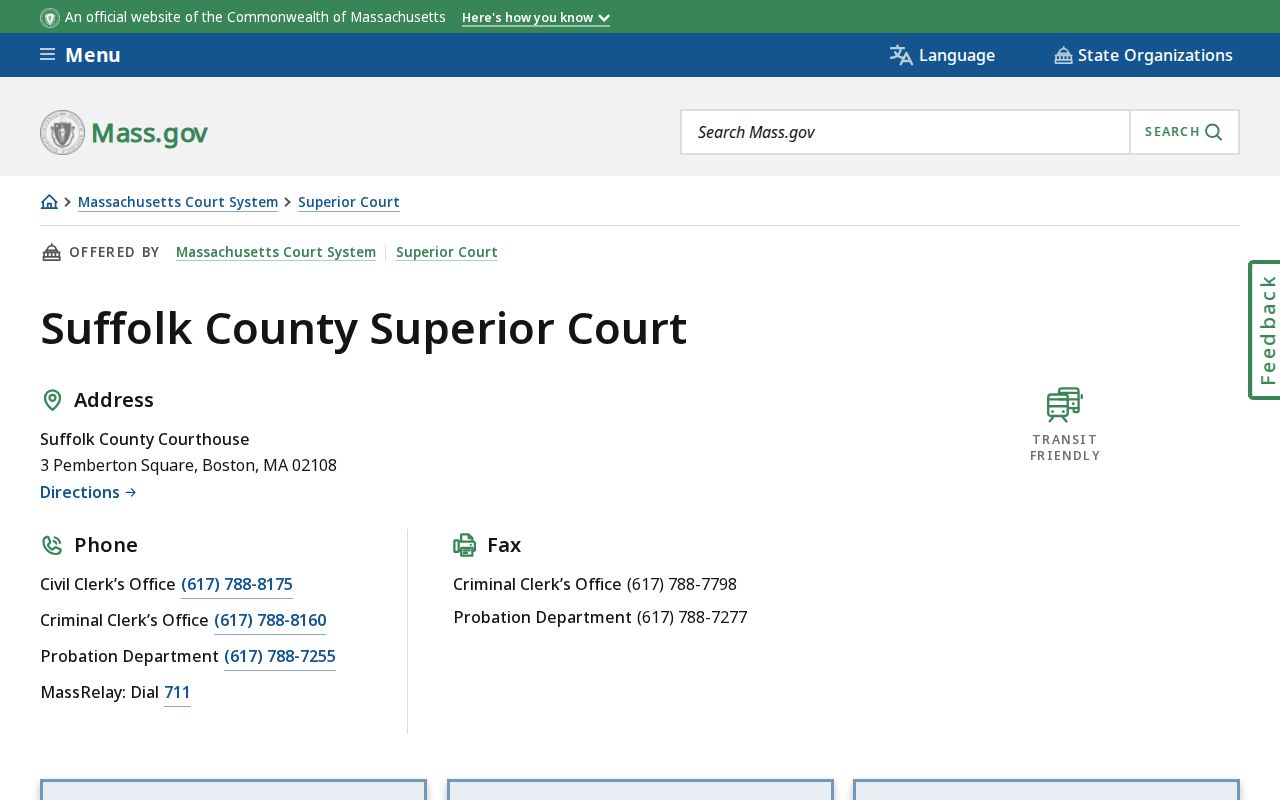
A notice naming Superior Court points to the Suffolk County clerk who can act.
Suffolk County Bench Warrant Remote Hearings
Remote hearings happen sometimes, never automatically. Joint Standing Order 1-26, effective June 1, 2026, covers the details. It allows remote hearings in certain District Court and Boston Municipal Court criminal compliance, election, status, and non-evidentiary motion matters. Some civil motor vehicle infraction hearings qualify too. Detention and violation matters do not. The order promises nothing for a bench warrant recall in Suffolk County, so ask the issuing clerk whether your matter qualifies and plan to attend in person if it does not.