
Checking for a Warrant in Suffolk County
A Suffolk County warrant check begins with a case, not a name. Your notice names a court department and usually a division. That one detail decides which clerk gets your call. The public docket at MassCourts eAccess wants a department, a division, and a location before it searches, and it accepts a case number, a citation number, or a name. Treat any result as a lead. The Trial Court itself says the portal is not the official record and may miss recent activity. The clerk's file controls.
- Pull the court, division, and case number off the notice.
- Search by case number first, because an exact number beats a name.
- If nothing shows, widen to another division or court.
- Call the issuing clerk and say you are checking a warrant.
- Ask what paper proves the court's action, then keep it.
Note: A name search can return rows for several people, so confirm the court and case before acting.
MassCourts and the Massachusetts WMS
Massachusetts runs two separate systems. Confusing them is the quickest way to reach the wrong conclusion about a Suffolk County warrant. MassCourts eAccess is public. The Warrant Management System is internal, and Chapter 276, section 23A describes its data and limits access to police through CJIS and to the Registry of Motor Vehicles. Nobody outside those channels queries it directly.
| System | Who can use it | What it answers |
|---|---|---|
| MassCourts eAccess | Anyone, no login | A docket clue: court and case events |
| Warrant Management System | Police and the RMV via CJIS | Current internal warrant data |
| Clerk's file | Public counter | Official status and recall steps |
That split explains a familiar frustration. A Suffolk County docket can show a default while no public field names the warrant status, because that field lives in the internal system. Read the event history. Then ask the clerk what the file says today. The Trial Court publishes instructions for searching court dockets covering the tabs and date limits, and that official page lays out exactly which tabs a visitor sees before any query runs, with no names involved.
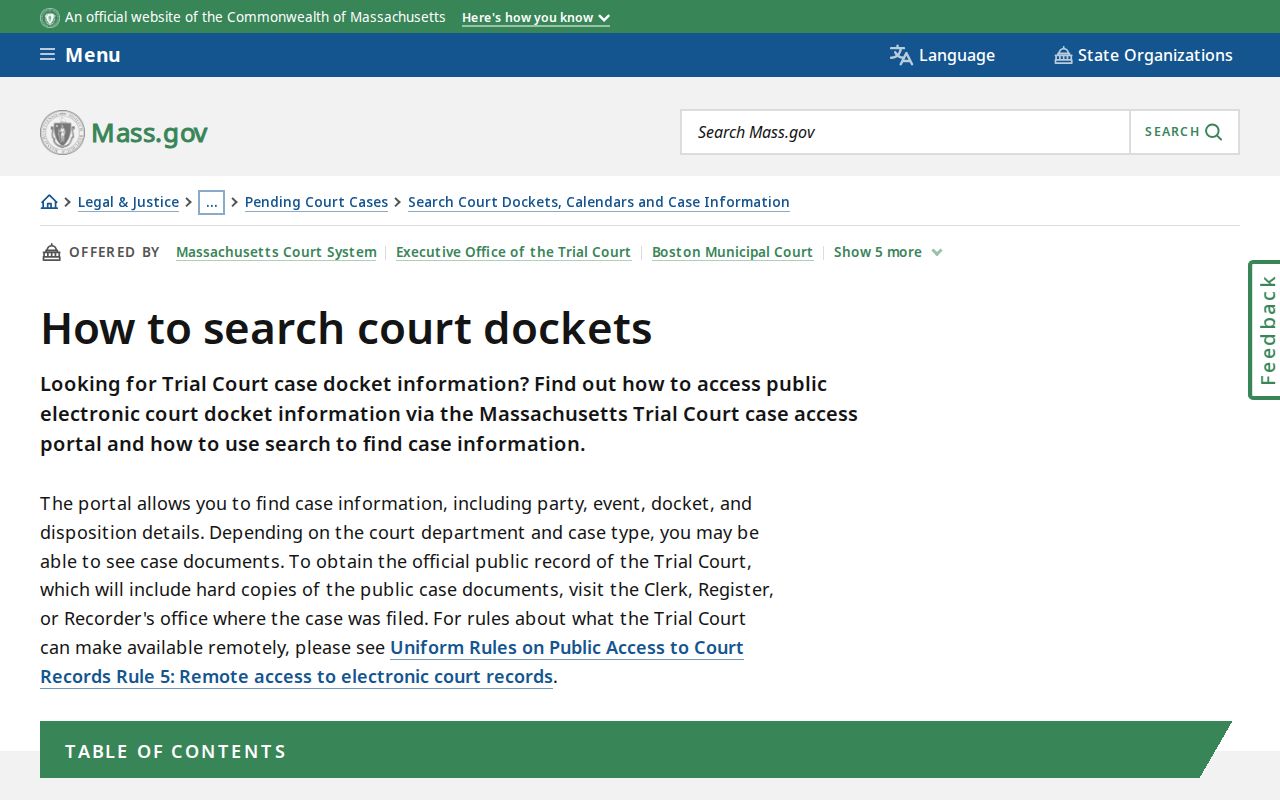
Following them keeps a search tied to a court and case.
Suffolk County Warrant Types
The label on your paperwork tells you which counter to call. Massachusetts guidance leans on arrest warrant and default warrant most often. A bench warrant describes process from the court, often after a missed date, and it may not show as its own field in a public portal. A civil capias belongs to support matters in Suffolk County, not the criminal system.
| Warrant Type | How It Arises | Who Issues It |
|---|---|---|
| Arrest warrant | A complaint, indictment, or missed date | The court holding the case |
| Default warrant | A missed court date or another default | The court that had the case |
| Payment-only default | An unpaid fine, cost, or restitution | The court handling the payment |
| Civil capias | Contempt or support service | A civil or family court |
Note: When the label on the paperwork does not match the counter you called, you are at the wrong office rather than out of luck.
Suffolk County Warrant Counts by Court
The Trial Court's FY2025 caseload report gives the clearest public picture of Suffolk County warrant volume. The counts are anonymous, court by court, with no names attached. It covers all eight Boston Municipal Court divisions.
Dorchester led both categories. It logged 410 criminal warrants and 888 administrative warrants. Roxbury, West Roxbury, and Central followed, which is why the division on your notice matters more than the word Boston in any Suffolk County search.
Note: Fiscal-year totals count case events rather than people, so they cannot show whether a warrant is still open.
Inside a Suffolk County Warrant Record
A warrant record is a short set of identifiers that routes paperwork to the right desk. The court comes first. A Suffolk County case can sit at any of eight Boston Municipal Court divisions, at Chelsea District Court, at Suffolk Superior, or at a Juvenile session. Then comes the case number. Formats vary by department, so copy the spacing and leading zeros exactly.
| Case Number | Department format, for example 2401CR001234, typed exactly. |
|---|---|
| Issuing Court | The department and location that opened the case. |
| Charge or Default Basis | The offense, missed date, or unpaid obligation. |
| Serving Agency | The police department or Sheriff unit assigned to serve it. |
| Status | Active, served, recalled, returned, or discharged, in the court's words. |
Two fields trip people up. An amount owed is not a bond, and a status such as disposed describes the Suffolk County case, not the warrant itself.
Suffolk County Warrant Terms in Plain Words
Clerks use words that rarely match what people search for. These five turn up constantly in Suffolk County cases.
- Default warrant
- Process that follows a missed court date or another default. The issuing court controls it.
- Recall
- The court withdrawing a warrant from active process. It does not erase the case or a fine.
- Quash
- An order setting process aside. Ask the clerk what the entry means in your case.
- Civil capias
- Civil contempt or support process, not a criminal arrest warrant.
Issuing and Serving Warrants in Suffolk County
Two offices sit behind every Suffolk County warrant. The court issues it. Under Rule 6, a District or Municipal Court can authorize a warrant in its own case, and Superior Court can do so after indictment. The issuing court alone controls recall, so a police station cannot clear one. Serving is a separate job. An officer authorized to serve criminal process executes the warrant, and chapter 276, section 23 allows certain warrants to be served anywhere in Massachusetts.
In Suffolk County, the Sheriff lists contacts for custody, civil process, and records instead of a criminal warrant table.
From Complaint or Default to Recall
A warrant follows a predictable path, and knowing your stage tells you which Suffolk County office to call. A case starts with a complaint or indictment. The court then chooses between a summons and a warrant. A missed appearance or an unpaid obligation can add a default.
Warrant flow: Complaint or citation › Hearing or default › Warrant entered in WMS › Service or appearance › Recall, discharge, or return › Written confirmation
Each step leaves a different office holding the record. The clerk holds the recall entry. The serving agency holds the execution record, and the Sheriff holds custody records, so one phone call rarely answers a Suffolk County warrant question in full.
If You Have a Warrant in Suffolk County
The issuing court controls recall, and every step runs through its clerk. Call the courthouse first. Confirm the location, the hours, and whether an appearance or motion is required. Then go to the clerk's office, say the purpose is to clear a warrant or default, and give the paperwork time to reach a judge. The judge may recall the warrant, set conditions, or impose a fee. Two statutory fees appear in the official material. A $50 fee can apply when a default warrant is recalled or issued solely for failure to pay, and a $75 arrest fee can follow an arrest on a bail or probation default. Both carry hardship waivers, so ask the Suffolk County clerk how to request one.
Important: Talk to a lawyer before you turn yourself in. An open warrant can surface at a traffic stop or a license transaction.
What to Bring to a Suffolk Warrant Counter
Bring the right papers and skip the second trip. Before you head to any Suffolk County warrant counter, call ahead to confirm the office, since clerk hours differ and every entrance runs security screening.
- The notice, citation, or complaint, with the case number visible.
- Proof that explains the missed date or the unpaid obligation.
- Photo identification for courthouse entry and for the counter.
- Your own phone contacts, plus childcare plans if the visit runs long.
- Any interpreter or disability accommodation request, made in advance.
In Boston, the Suffolk Superior criminal clerk works from the 14th floor at 3 Pemberton Square. That office answers warrant questions at (617) 788-8160.
Suffolk County Warrant Records and Public Access
One warrant record, two access rules. Suffolk County court records follow the Trial Court's access rules, open at the clerk counter, a courthouse kiosk, or the public portal when a case qualifies. Records held by a city, a police department, or the Sheriff fall under the Massachusetts Public Records Law instead.
Key Rules:
Chapter 276, section 23A - describes the state warrant database and the duty to update it quickly.
Trial Court Rule XIV - sets the access baseline and the limits for sealed, impounded, and juvenile records.
Massachusetts Public Records Law guide - explains agency requests and the appeal route.
Note: Juvenile cases in Suffolk County carry confidentiality rules, so a blank portal result does not rule out an active warrant.
Who Holds Which Suffolk County Warrant Record
Asking the wrong office wastes a day. Every Suffolk County agency holds only one layer of warrant records, and each layer has limits.
| Office | What it holds | What it cannot do |
|---|---|---|
| Issuing court clerk | The case file and the recall entry | Nothing. This office acts on warrants. |
| Sheriff records staff | Custody records and civil service | Recall a court warrant |
| City or town police | Incident and service reports | Clear a court warrant |
| Federal court and Marshals | Federal dockets and task force contacts | Touch state court warrant data |
Is There a Public Suffolk Warrant List?
Suffolk County posts no complete public list of active warrants. The Sheriff publishes custody and civil contacts rather than a warrant table. The Trial Court offers a docket search, not a warrant feed. The Boston Police Department's Most Wanted category is a dated program, not a full inventory. What exists instead is a chain: a docket points to a case, the issuing clerk confirms the warrant status, and a payment or court appearance moves the matter forward. Treat anything billed as a complete county list with caution.
Suffolk County Warrants by City
Suffolk County has four municipalities, and each routes court business its own way. Boston and Winthrop cases usually open in a Boston Municipal Court division. Chelsea and Revere adult cases go to Chelsea District Court instead.
Boston Warrant Search
675,647 (2020 Census) · Eight BMC divisions plus Suffolk Superior
Revere Warrant Search
62,186 (2020 Census) · Adult cases go to Chelsea District Court
Chelsea Warrant Search
40,787 (2020 Census) · District and Juvenile courts at 120 Broadway
Winthrop Warrant Search
19,316 (2020 Census) · East Boston BMC covers much of the town