
Checking for a Warrant in Chelsea
Start with the paper you already have. It names the court that owns the case. Chelsea has no city-run criminal court, so adult matters belong to the District Court on Broadway. Before calling the clerk, check the public docket at MassCourts eAccess, which shows the events logged on a Chelsea case.
- Copy the court and session off the citation or hearing notice.
- Search that court by case or ticket number, not by name alone.
- Call the clerk's office and ask about a default or warrant.
- Ask whether the matter is civil, criminal, or a payment-only default.
- Ask for written proof of any court action, then keep it.
A police report and a court file are two different records. Chelsea police can tell you what their officers handled; the clerk decides whether a warrant still stands.
Chelsea Warrants at 120 Broadway
Two courts share the building at 120 Broadway, and they run separate counters. Chelsea District Court takes adult criminal, civil, and traffic matters for Chelsea and Revere, including adult drug and mental health sessions. Chelsea Juvenile Court sits at the same address and serves Chelsea, Revere, East Boston, and Winthrop for delinquency, harassment, and criminal cases. Juvenile access rules are tighter, and the counter phone differs. Ask which court holds the case before you travel. The Chelsea Juvenile Court page describes the four communities that session covers.
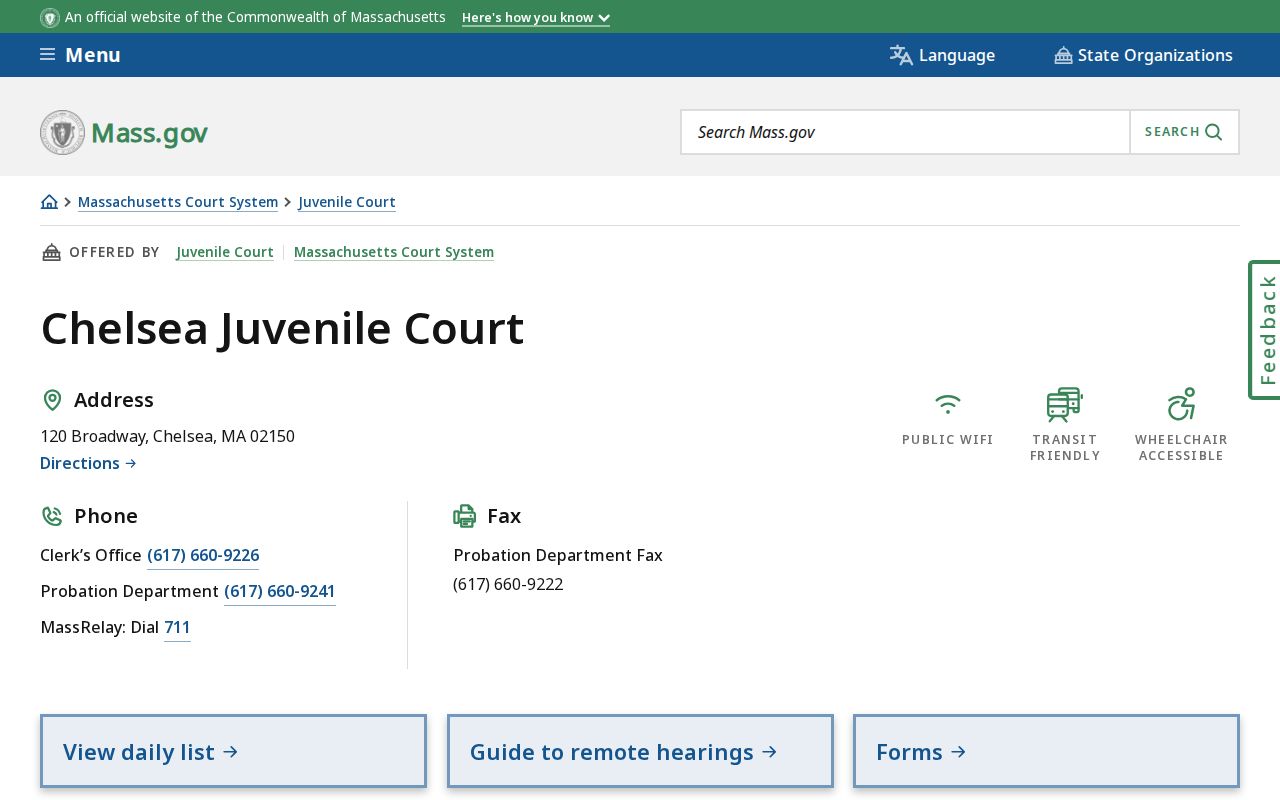
Knowing which court holds the file saves a second trip to the same building.
Chelsea Police and Municipal Court
Chelsea police and the municipal court handle separate jobs. The department serves process and keeps reports, while the District Court holds the docket that shows whether a warrant is still open.
Chelsea Police Department
19 Park Street, Chelsea, MA 02150
Verify the current records counter line before you visit
Chelsea District Court
120 Broadway, Chelsea, MA 02150
(617) 660-9200
cmchelseadc@jud.state.ma.us
There is no separate Chelsea Municipal Court for adult warrants. A request under that name belongs with the District Court.
Chelsea Warrant Counters and Hours
Two offices inside the courthouse handle most warrant questions, and knowing which one to ask for saves a trip. The Clerk's Office answers questions about the case file, the docket, and whether a default or warrant was entered. Probation handles questions about a supervised case. Call the clerk at (617) 660-9200 and probation at (617) 660-9300, and each has its own fax line. Counters are open Monday through Friday, 8:30 a.m. to 4:30 p.m. Bring the case number if you have one, because staff can pull a file faster with a number than with a name in Chelsea's system.
Chelsea Warrant Types
Chelsea cases come down to a few warrant labels, and each label points to a different counter. Massachusetts public guidance mostly speaks of default warrants and arrest warrants, so start with whichever one matches your paper.
| Warrant Type | How It Arises | Who Issues It |
|---|---|---|
| Arrest warrant | A complaint, indictment, or missed date | The court holding the case |
| Default warrant | A missed appearance or other default | The court that had the case |
| Payment-only default | An unpaid fine, cost, or restitution | The court handling the payment |
| Traffic default | An unpaid citation or missed traffic hearing | Chelsea District Court |
| Civil capias | Contempt or a support order | A civil or family court |
Civil Capias Is Not a Chelsea Warrant
Capias is the word that sends people to the wrong office most often. In Massachusetts it shows up in civil contempt and support matters, not the ordinary criminal warrant process. A civil capias requires a court-issued order and is served by the Sheriff's Civil Process Division. That division works from 132 Portland Street in Boston, takes calls at (617) 704-6999, and charges a fee up front with no waiver. A family or support order may come from Suffolk Probate and Family Court, which also keeps a Tuesday through Thursday satellite at 120 Broadway. Keep the civil and criminal tracks apart in Chelsea, because a criminal clerk cannot answer a capias question.
Inside a Chelsea Warrant Record
A court file carries a small set of fields. Read them in order and you will know whether you are looking at the right Chelsea case.
| Case or Citation Number | The docket identifier, for example 2411CR001044; spacing and leading zeroes matter. |
|---|---|
| Charge or Default Basis | The offense, or the missed hearing or unpaid amount behind the default. |
| Issuing Court | The court and session that controls the case, usually the District Court. |
| Serving Agency | The police department or Sheriff unit assigned to execute the warrant. |
| Status | Active, served, recalled, returned, or discharged. |
Is There an Online Chelsea Warrant Search?
Chelsea publishes no online warrant search portal, and the state does not publish one either. The Warrant Management System is internal; chapter 276, section 23A limits it to police through CJIS and to the Registry of Motor Vehicles. What the public does have is a docket search that can show a default event, plus a clerk who can read the file. The city of Chelsea also has no self-service recall form. That is not a dead end, only a slower route with a real answer at the end.
How Chelsea Warrants Fit the County System
A Chelsea warrant case sits inside the county's court system. The issuing court enters the warrant. The serving agency then executes it, while the statewide data tracked under chapter 276, section 23A keeps the case connected across agencies.
Warrant flow: Chelsea District Court or Chelsea Police › Suffolk County Sheriff › Warrant Management System
Jail custody and court status are two different facts. A Chelsea jail records answer never clears a warrant. The city court layer gets fuller treatment on the Suffolk County municipal warrant page, and the county-wide steps begin at Suffolk County warrant records.
Chelsea Police Records Versus Warrant Status
A public records request asks an agency for what it holds, nothing more. Under the Massachusetts Public Records Law, that covers a department policy, a retention schedule, an incident report, or an aggregate count of activity. It does not return a warrant status. It cannot clear one, either. So send your request to the Chelsea Records Access Officer with a date range and a record category spelled out. Confirm the current records counter number before mailing anything, since the official listings show more than one administrative line for the department.
Chelsea Warrant Records and Public Access
Two access rules govern a Chelsea case. City and police records answer to the public records law. Court files sit under the Trial Court's access rules instead, where juvenile and sealed material stays closed.
Key Rules:
Massachusetts Public Records Law (G.L. c.66) covers city and police records, and requests go to the holding agency's Records Access Officer.
Trial Court Rule XIV governs court files, and sealed, impounded, and juvenile records remain restricted.
Disclosure rules for confidential information explain why a juvenile case can exist without appearing in a public portal.
Parking and Transit for Chelsea Warrants
MBTA bus routes 111, 112, 114, 116, and 117 stop at the Chelsea courthouse at 120 Broadway, and the official location page notes public Wi-Fi and wheelchair access. Parking is metered or in nearby lots. The commuter rail station sits more than a mile out. A bus is the easier ride for most visitors. On a hearing day, build in extra time. If you only need a warrant status, call the clerk first. Most warrant questions can be handled by phone, so a trip is often avoidable.