
Checking for a Warrant in Boston
Let the notice pick your starting point. A Boston citation, summons, or hearing notice names a court department and usually a division, and that division holds the file. Begin there rather than with a broad city search. No Boston agency publishes one list of every open warrant. The public docket at MassCourts eAccess wants a department and a division before it will search at all.
- Read the court department and division off the notice or citation.
- Search that division by case number first, since an exact number beats a name.
- Call the division clerk and ask whether a default or warrant sits on the case.
- If the charge is a felony, ask the Suffolk Superior criminal clerk about it.
- Ask which document proves a recall, then keep that paper.
A Boston police report is a separate record. The court alone controls whether the warrant stands.
Which Boston Division Holds a Warrant?
Boston Municipal Court runs eight divisions, and each keeps its own dockets. Match the area printed on your notice to the right one. Central, for instance, covers Downtown Boston, Chinatown, the North End, the South End through Massachusetts Avenue, the West End, and Beacon Hill.
| Division | Address | Phone |
|---|---|---|
| Brighton | 52 Academy Hill Road, Brighton | (617) 782-6540 |
| Central | 24 New Chardon Street, Boston | (617) 788-8600 |
| Charlestown | 3 City Square, Charlestown | (617) 242-5400 |
| Dorchester | 510 Washington Street, Dorchester | (617) 288-9500 |
| East Boston | 37 Meridian Street, East Boston | (617) 569-7550 |
| Roxbury | 85 Warren Street, Roxbury | (617) 427-7000 |
| South Boston | 535 East Broadway, South Boston | (617) 268-9292 |
| West Roxbury | 445 Arborway, Jamaica Plain | (617) 971-1200 |
Copy the division name exactly as printed. One division's check says nothing about the other seven. Every location keeps weekday hours of 8:30 a.m. to 4:30 p.m.
Boston Police and Municipal Court
Two Boston offices answer different questions. Police serve court-issued warrants and hold the arrest reports. The municipal court decides what happens to the case afterward.
Boston Police Department
One Schroeder Plaza, Boston, MA 02120
(617) 343-4500
Public service counter: (617) 343-4633
Boston Municipal Court
Administrative Office, 24 New Chardon Street, 6th floor
(617) 788-8700
Eight divisions, weekday counter hours only
Report requests go to the Boston department, not the clerk. Email POLICEREPORT@PD.BOSTON.GOV with a date, a location, and photo identification.
Boston's Superior Court Warrant Files
Felony and indictment matters sit outside the municipal divisions. They belong to the Suffolk Superior Court criminal clerk at 3 Pemberton Square, 14th floor. The counter phone is (617) 788-8160. Weekday hours run 8:30 a.m. to 4:30 p.m. Rule 6 of the Rules of Criminal Procedure allows a Superior Court warrant after indictment.
Note: The Superior civil clerk and the probation office sit on other floors and handle other business, so a criminal warrant question belongs with the criminal clerk.
Boston Warrant Types
A few labels cover most Boston cases, and the label points you to the right counter. Massachusetts public guidance uses default warrant and arrest warrant. Civil capias belongs to family and support matters.
| Warrant Type | How It Arises | Who Issues It |
|---|---|---|
| Arrest warrant | A complaint or indictment, or a missed date | The court holding the case |
| Default warrant | A missed appearance or another default | The court that had the case |
| Payment-only default | An unpaid fine, cost, or restitution order | The court handling the payment |
| Civil capias | Contempt or a support order | Probate and Family Court |
| Juvenile default | A delinquency or harassment case | The assigned Juvenile session |
Boston JustFOIA Is Not a Warrant Recall
Boston's records portal invites bigger hopes than it can meet. The city switched its requests from GovQA to JustFOIA, and the Public Records Office sits at 26 Court Street, reachable at (617) 635-4037 or publicrecords@boston.gov. It answers for the records Boston itself holds. Think police reports, policies, or an aggregate count. It cannot recall a court warrant, so whatever the city says about a document is not a word on warrant status. That power sits with the issuing court alone.
The timelines and fees are worth knowing before you file. The city responds within 10 business days, and it can extend by 15 days with a written explanation. If you disagree with an answer, an appeal goes to the Supervisor of Records within 90 days. Paper copies cost $0.05 per page. The first two hours of staff search time are free, and work beyond that is generally capped near $25 per hour. The Boston Public Records Office page spells out the request methods, the fees, and the response windows Boston follows.
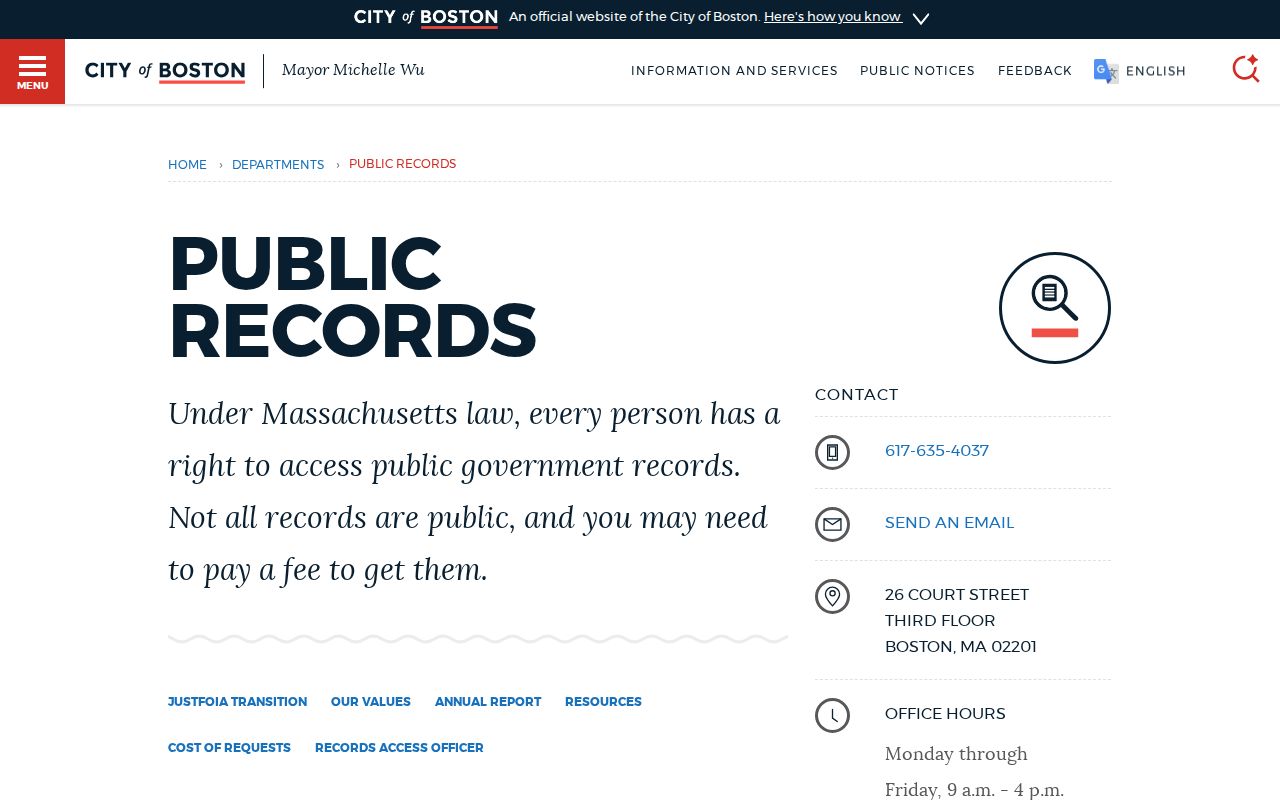
It answers for city records only, never for a court warrant.
Inside a Boston Warrant Record
A Boston court file carries a small set of fields. Read them in order and you will know whether you have the right case.
| Case Number | The docket identifier, for example 2401CR001234; capitalization and leading zeroes matter. |
|---|---|
| Charge or Default Basis | The offense, or the missed date or unpaid amount behind the default. |
| Issuing Court and Division | The department and the specific division that controls the case. |
| Serving Agency | The police department or Sheriff unit assigned to execute the warrant. |
| Status | Active, served, recalled, returned, or discharged. |
Boston Warrant Counts by Division
The Trial Court publishes fiscal-year totals, not a live list. The FY2025 caseload report shows the volume Boston Municipal Court handles across its eight divisions.
Administrative warrants outnumbered criminal ones, so the label matters when a number is quoted. Boston counts like these are aggregates, not a status.
How Boston Warrants Fit the County System
A Boston warrant is still a county warrant. The issuing court enters it and the serving agency executes it. Chapter 276, section 23A describes the statewide warrant data that police and the Registry of Motor Vehicles can see through CJIS.
Warrant flow: BMC division or Boston Police › Suffolk County Sheriff › Warrant Management System
Custody is a separate question from court status, so a jail answer never clears a warrant. For the full county picture, start with Suffolk County warrant records.
Boston Most Wanted Versus a Warrant
The Boston Police Department keeps a Most Wanted category, and it works as a curated outreach tool rather than a warrant ledger. Each post carries its own warning that the information was validated on the posting date and must be verified before police action. CrimeStoppers is the tip side of that program. Tips come in by phone at 1-800-494-8477, by texting TIP to CRIME (27463), or through a P3 form that accepts photos and video. A submission returns a six-digit tip ID and password. A board decides whether information merits an award, and no fixed reward cap appears in the official material. Read more about how the program works on the Suffolk County Most Wanted List page.
Boston Warrant Records and Public Access
Boston warrant records sit in two different systems. Police and city files answer to the state public records law, while court files answer to the Trial Court's own access rules. Either way, some material stays closed to everyone.
Key Rules:
Massachusetts Public Records Law (G.L. c.66) covers city and police records, and requests go to the holding agency's Records Access Officer.
Trial Court Rule XIV governs court files, and sealed, impounded, and juvenile records stay restricted.
Chapter 276, section 2B keeps a search-warrant affidavit nonpublic until the return is filed.
When a Boston Notice Names No Division
Older Boston paperwork sometimes names only Boston Municipal Court, with no division listed. That is still workable. Pull the case number first, since the docket tied to it names the division. If the number is missing too, call the BMC administrative office at (617) 788-8700 and ask how to locate the case. You can also try the division nearest where the citation was issued. Ask the clerk to read back the division and the case number, then write both down. Bring that Boston note with you on any courthouse visit.